How Do 3D Printers Work? Simple Beginner Guide
Direct Answer Summary
So, how do 3D printers work? A 3D printer creates physical objects by adding material layer by layer based on a digital design. This process is called additive manufacturing. The machine reads a G-code file from slicing software, heats a material like PLA plastic, and deposits it onto a print bed.
Key Takeaways
- 3D printing builds objects one layer at a time using digital files.
- Fused Deposition Modeling is the most common beginner method.
- You need a 3D model, slicing software, and filament to start.
- A good first layer is critical for print success.
Who This Is For
This guide is for hobbyists, students, and beginners who want to understand 3D printing basics. If you want to buy your first machine or learn digital fabrication, this article will help you start.
How Do 3D Printers Work? The Basic Process
A 3D printer turns a digital file into a real object. This technology is known as additive manufacturing. Traditional manufacturing cuts material away. 3D printers add material exactly where it is needed.
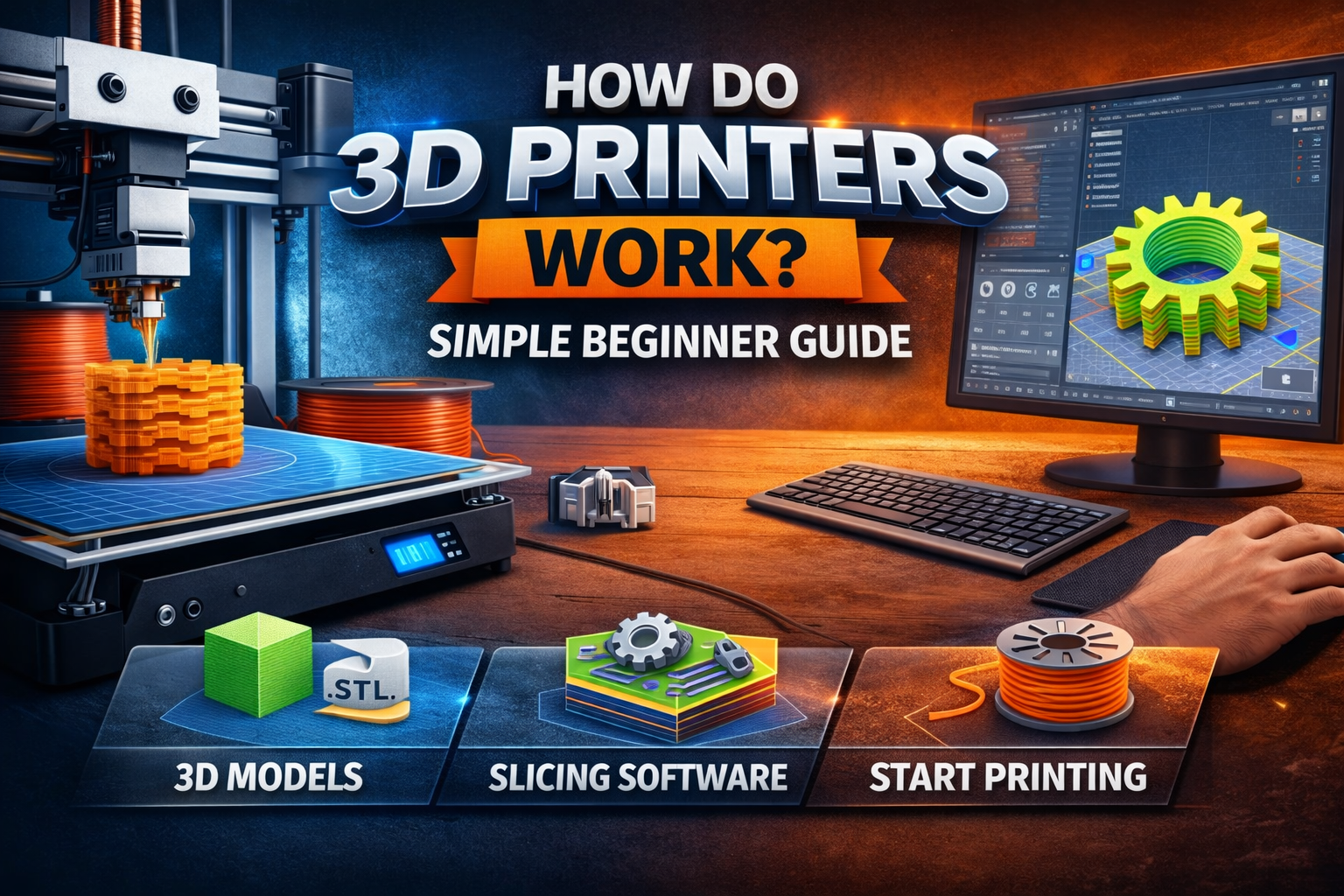
The most common technology for beginners is Fused Deposition Modeling. People also call this Fused Filament Fabrication. The printer pulls a plastic thread from a filament spool holder. The material travels to a heated nozzle called a hot end. The hot end melts the plastic. Stepper motors move the nozzle around the print bed. The printer deposits the extruding material in thin lines.
Step 1: Create or Find a 3D Model
Every print starts with a digital design. You can create one using CAD (Computer-Aided Design) or 3D design software. You can also download pre-made STL files from online libraries. These 3D models act as the blueprint for your object.
Step 2: Prepare the Slicing Software
Your printer cannot read an STL file directly. You must use slicer software like BCN3D Cura. The slicing software cuts your digital file into hundreds of horizontal layers. You can adjust settings like layer height and infill patterns here. The software then exports a G-code file. This file tells the printer exactly where to move and how hot it should be.
Step 3: Print the Object
You load the G-code file into the printer. A temperature sensor ensures the hot end reaches the right heat. The printer lays down the first layer. A perfect first layer is essential for the object to stick to the bed level. The printer then stacks layer lines on top of each other until the object is complete.
Different Types of 3D Printing
Beginners usually start with FDM 3D printing using PLA plastic or ABS plastic. However, other methods exist.
Resin 3D printing uses a liquid resin instead of solid plastic. A screen flashes light to cure the liquid into solid layers. A resin printer creates highly detailed parts.
Selective Laser Sintering uses a laser to melt polymer powder. Industries use this for customized end-use products and rapid prototyping.
FDM vs Resin Printers
| Feature | FDM Printers | Resin Printers |
| Material Used | Plastic filament (PLA, ABS) | Liquid UV resin |
| Detail Level | Good | Excellent |
| Ease of Use | Very beginner friendly | Requires safety gear |
| Best For | Large parts, functional tools | Miniatures, jewelry |
Pros and Cons of 3D Printing
Pros
- You can create custom parts at home.
- Additive manufacturing creates very little waste.
- You can easily share and download digital files online.
- Great tool for learning CAD and engineering.
Cons
- Learning slicing software takes time.
- Prints can fail if the print bed is not level.
- Some machines require frequent maintenance.
Common Beginner Mistakes
- Ignoring the bed level: If the print bed is not flat, the first layer will fail. Use auto bed leveling if your machine has it.
- Forgetting support structures: Plastic cannot print in thin air. You must add support material in your slicer software for overhangs.
- Wrong filament selection: ABS plastic needs a heated chamber. Beginners should always start with PLA plastic.
Frequently Asked Questions
Is 3D printing hard to learn?
It takes some practice. Modern slicers and auto bed leveling make the learning process much easier for beginners today.
How long does a 3D print take?
Print times vary widely. A small coin might take ten minutes. A large helmet can take over three days to finish.
What materials can I use?
Beginners mostly use PLA plastic. Advanced users print with ABS, nylon, flexible TPU, or even liquid resin materials.
How much does a 3D printer cost?
A basic FDM printer costs around two hundred dollars. Professional machines for rapid prototyping cost thousands of dollars.
Start Your 3D Printing Journey
Learning how do 3D printers work opens up a new world of creativity. You can fix broken household items or invent customized end-use products. Start by downloading some free STL files and experimenting with slicing software. With a little patience, you will turn digital ideas into physical reality.